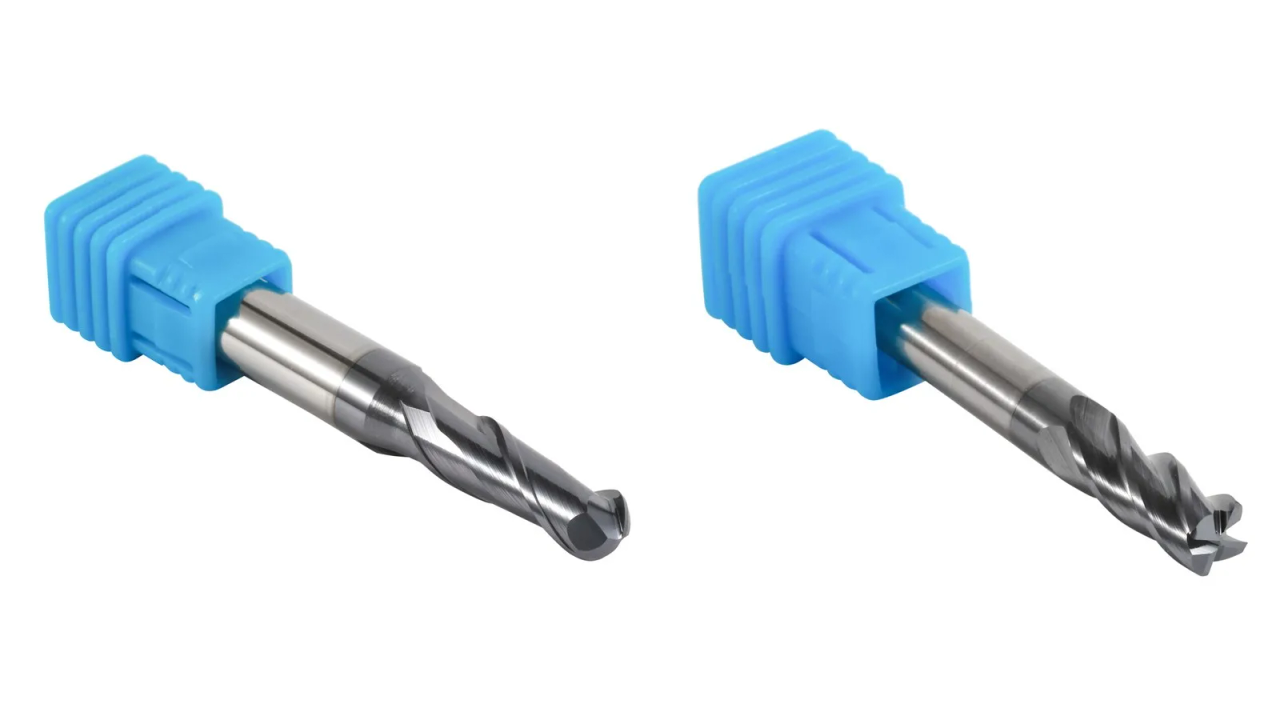
A square, a corner radius and a ball nose end mill differ in one place: the corner where the end of the tool meets the side. That corner decides the shape the tool leaves in the part, how strong the cutting edge is, and which jobs the tool suits. Start from the drawing and the choice is usually clear.
Three corner shapes
| Square | Corner radius (bull nose) | Ball nose | |
|---|---|---|---|
| End of the tool | Flat, sharp corner | Flat, small radius at each corner | Half-sphere, radius = half the diameter |
| Floor | Flat | Flat | Scallops, unless the stepover is small |
| Floor to wall | Sharp corner | The tool’s corner radius | A radius of half the diameter |
| Cutting corner | Sharp, usually wears first | Rounded, stronger | None |
| Typical work | Slots, square shoulders, sharp inside corners | Fillets to drawing, roughing, hardened steel | 3D surfaces, moulds, finishing |
Square end mills
A square end mill leaves a flat floor and a sharp corner between floor and wall. Use it when the drawing calls for a sharp inside corner, for slotting, and for shoulders that have to be square.
The sharp corner is also the most loaded and least supported part of the edge. It is usually where wear and chipping start, especially in harder materials or with interrupted cuts.
Corner radius end mills
A corner radius end mill — often called a bull nose — is flat on the end, with a small radius ground on each corner. It still faces, pockets and cuts shoulders like a square tool. The radius puts more material behind the edge exactly where a square corner is weakest, so the edge usually holds up better in roughing and in hardened steel.
The tool leaves its own radius between the floor and the wall. Check the drawing before choosing: the part must allow that fillet. If it calls for a sharp corner, a corner radius tool cannot finish it.
Ball nose end mills
A ball nose end mill has a cutting edge running around a half-sphere, so it can follow sloped and curved surfaces in 3D. That makes it the usual finishing tool for moulds, dies and freeform parts.
Between passes a ball nose leaves small ridges, called scallops or cusps. Their height depends on the ball radius R and the stepover s:
h = R − √(R² − (s / 2)²)
A larger ball lets you use a wider stepover for the same finish; a smaller stepover gives a smoother surface but a longer program. On a flat floor a ball nose needs many close passes, so a square or corner radius tool is usually quicker there.
At the very centre of the ball the cutting speed is close to zero. Where the machine allows it, tilt the tool or the part so the centre is not doing the cutting.
A tapered ball nose adds a conical neck behind the ball. The taper makes the tool stiffer than a straight-neck tool of the same tip size and reach, which helps on deep, narrow features such as ribs in a mould cavity.
Corner radius or ball nose: how to decide
- Flat floor with a small fillet — corner radius end mill, with the radius the drawing allows.
- Sloped or freeform surface — ball nose end mill; choose the ball radius and stepover for the surface finish you need.
- Roughing a 3D shape before finishing — a corner radius tool is a common choice for roughing, because its flat end removes more per pass; a ball nose then finishes the surface.
- Sharp inside corner — square end mill.
- Deep, narrow rib or cavity — tapered ball nose end mill.
What to send with an enquiry
- The drawing, with the fillet radius or surface finish called out
- Workpiece material and hardness
- Diameter, reach and shank you need
- Quantity per size
Our range
Corner radius (Φ1–20 mm, R0.2–R3) and ball nose (R0.5–R10) end mills for steel in HRC55, HRC58 and HRC60 series; 4-flute ball nose Φ4–20 mm and tapered ball nose 2°, 3° and 5° per side, tip Φ1–6 mm, in catalog chapter 04 (p.93–94).
Square end mills and aluminium U-flute end mills. Other diameters, radii and reaches are made to your drawing.