
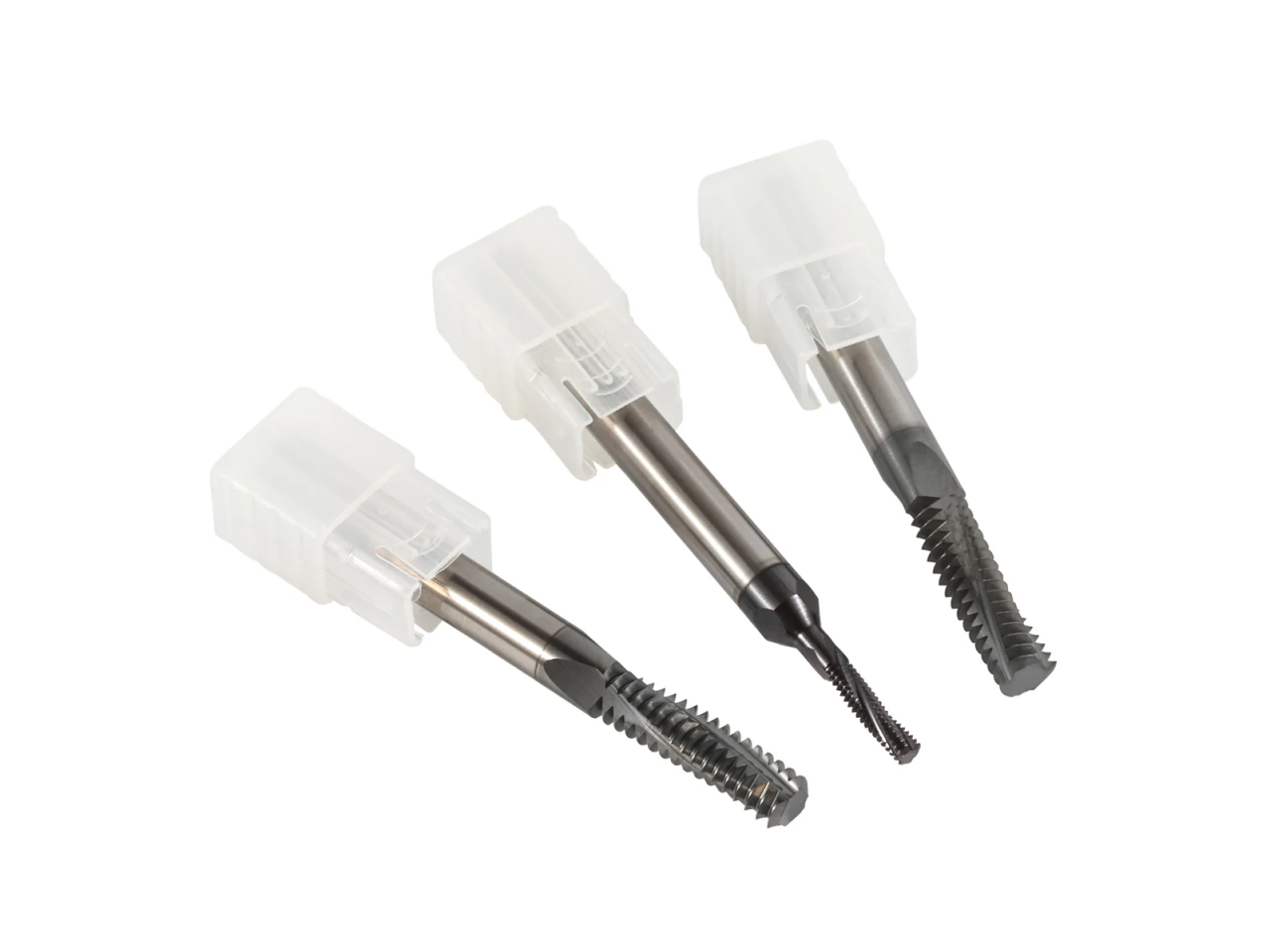
Most internal threads are still cut with a tap, and for good reason: a tap is simple, fast and cheap per hole. But on CNC machining centres, thread milling has become the better choice for a growing share of jobs — particularly where the part is expensive, the material is difficult, or the thread sizes vary. This guide sets out how the two methods differ and how to choose.
How each method works
Tapping cuts or forms the full thread in one axial pass. The tap’s diameter and pitch are fixed, so one tap makes one thread size. On a machining centre it needs the spindle and feed to stay synchronised with the pitch, then reverse out of the hole.
Thread milling uses a rotating cutter that is smaller than the hole. The machine moves the cutter along a helical path — a circle in X and Y while it advances one pitch in Z per revolution. The thread diameter comes from the toolpath, not from the tool, so the same cutter can produce different diameters at the same pitch.
What changes in practice
One cutter, several sizes. Because the diameter is set by the program, a single thread milling cutter covers a range of thread sizes at the same pitch. That can reduce the number of tools in the magazine, especially for low-volume or mixed work.
Thread size is adjustable. If a thread gauge is tight or loose, a thread mill can be corrected with a small radius offset. A tap’s size is fixed; a worn or oversize tap has to be replaced.
Tool breakage is less costly. A broken tap can lock into the hole and scrap an expensive part. A thread milling cutter is smaller than the hole, so a broken cutter may leave the part recoverable — depending on the damage and the application.
Chips are easier to control. Thread milling produces short chips and leaves room around the tool, which helps in blind holes and in materials that produce long, stringy chips.
Tapping is usually faster for small, standard threads. For a common thread size in a free-cutting material and high volumes, a tap often finishes the hole in less time and with a simpler program.
Machine and programming requirements
Thread milling needs a CNC that can interpolate a helix — three axes moving together. Most modern machining centres can, and CAM systems generate the toolpath. Tapping needs rigid tapping or a floating tap holder, and in deep or tough-material holes, reliable chip evacuation.
Choosing between them
A thread milling cutter is usually the better choice when:
- the part is valuable and a broken tool would scrap it
- the material is hard, tough or gummy, such as hardened steel, titanium or stainless steel
- you need several thread sizes at the same pitch, or odd sizes a stock tap does not cover
- the thread is large, where a tap needs high torque
- the thread runs close to the bottom of a blind hole
- you need to adjust the thread fit without changing the tool
A tap is usually the better choice when:
- the thread is small and standard, the material cuts freely and volumes are high
- the machine cannot interpolate a helix
- cycle time per hole matters more than tool flexibility
Choosing a thread milling cutter
Three geometries cover most work:
- Single-tooth cutters cut one thread form per revolution. They are the most flexible across pitches and thread lengths, and cut with low forces.
- Three-tooth cutters balance cutting time and flexibility.
- Full-thread cutters cut the whole thread length in one helical revolution — the fastest option when the thread length and pitch match the cutter.
Extended-reach versions reach threads deeper in the part or behind a shoulder.
Our standard solid carbide thread milling cutters run from M0.8 to M36 in single-tooth, three-tooth and full-thread geometries, including extended-reach, 3×D and 4×D versions; selected full-thread sizes extend to M80 depending on pitch. Aluminium and steel geometries are supplied separately, and inch pitches are covered by the 60° range series. See the thread milling cutter range for full size tables.
What to send for a quote
To match a thread milling cutter to your job, send the thread callout (for example M8×1.25), internal or external, the thread depth, whether the hole is blind or through, the workpiece material and hardness, and your machine. For special profiles or tapered threads, send a drawing — see what to send for a custom tool quote, or request a quote.