
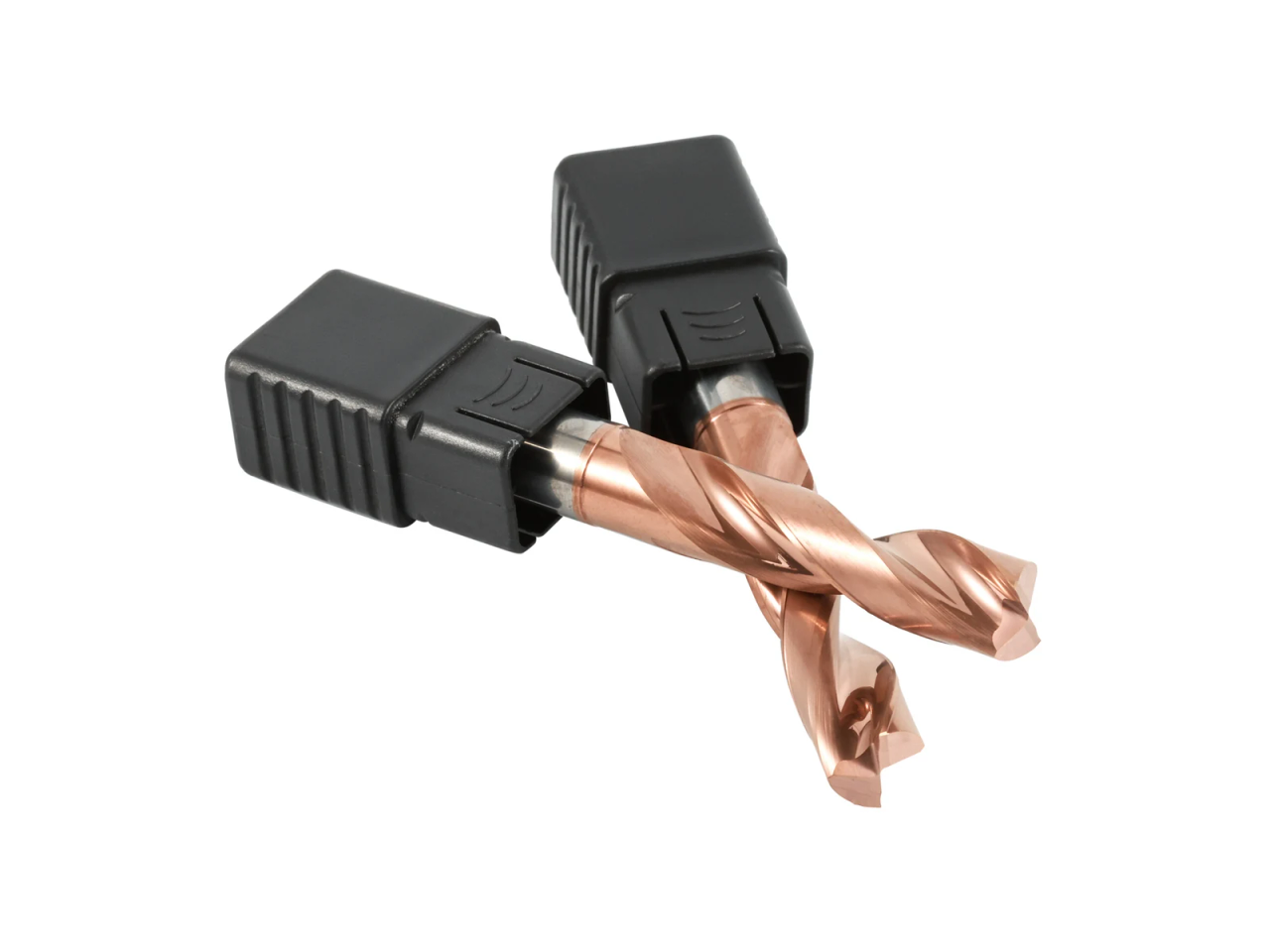
A standard twist drill leaves a cone at the bottom of a blind hole. When the part needs a flat floor — for a seal, a seated component or a counterbore — there are two common ways to get it: finish the hole with an end mill, or drill it with a flat bottom drill in the first place. Both work. The better choice depends on the hole and the machine time you want to spend on it.
What a flat bottom drill does
A flat bottom drill is a solid carbide drill with a flat point instead of a drill-point cone. It is designed to plunge axially and leave a flat floor. Because the point is flat, it also starts well on surfaces a normal drill would skid on: inclined faces, curved surfaces and uneven or cast skin.
What an end mill does
An end mill is designed mainly to cut sideways. Most end mills can plunge a short distance, but many are not intended for deep axial plunging, and chip evacuation in a deep blind hole is limited. An end mill can, however, make a flat floor of any size by interpolating — moving in a circle or a pocket path.
When a flat bottom drill is the better choice
- Flat-bottomed blind holes where you would otherwise drill, then mill the floor flat. One tool and one operation replace two.
- Counterbores and spot faces that match the drill diameter.
- Starting holes on inclined, curved or uneven surfaces, where a pointed drill would walk off position.
- Half-holes and intersecting holes, where one side of the tool is cutting in air or crossing another bore.
- Holes deeper than an end mill can plunge comfortably, within the flute length of the drill.
When an end mill is the better choice
- Wide pockets or floors larger than any single drill diameter, or shapes that are not round.
- Side milling and profiling, where the tool has to cut along a wall.
- Holes where the diameter must be adjusted, since an interpolated end mill path can be changed in the program.
- Very shallow flat areas, where plunging deep is not needed at all.
Practical points before choosing
Diameter and depth. A flat bottom drill makes one diameter per tool. Check that a standard size matches your hole, and that the required depth sits within the drill’s flute length.
Machine rigidity and set-up. Flat-point drilling on an inclined surface puts side load on the tool at entry; a rigid set-up and a sensible entry feed help.
Floor requirements. If the floor needs a specific corner form — for example a radius where the floor meets the wall — a standard flat bottom drill may not match it; a custom geometry or an end mill finishing pass may be needed.
Cycle time. For a single round, flat-bottomed hole, a flat bottom drill is usually the quicker route because the hole and the floor are made together. For multiple features in the same set-up, an end mill that can also do other work may keep the tool count down.
Our range
Our solid carbide flat bottom drills cover Φ1–16 mm as standard; other diameters and lengths are made to drawing. The full size table is on the flat bottom drill page. For side milling and pocketing, see our end mills.
What to send for a quote
Send the hole diameter and depth, blind or through, the surface the drill enters (flat, inclined or curved), the workpiece material, and any requirement for the floor or the corner. For stepped or special profiles, a drawing is fastest — see what to send for a custom tool quote, or request a quote.